

How to Choose the Right Drip Irrigation System for Your Farm
Choosing the right drip irrigation system is not simply a matter of selecting a drip tape or pipe. Crop type, planting layout, irrigation length, water quality, operating pressure, emitter spacing and expected service life can all affect system performance.
A properly selected system can improve water distribution, reduce unnecessary water use and make irrigation management more efficient.
A poorly matched system, on the other hand, may result in uneven irrigation, clogging, leakage or higher operating costs.
In this guide, we look at the main factors to consider when selecting drip irrigation products for farms, greenhouses, nurseries and other agricultural applications.
1. Start with the Crop and Application
The first step is to understand where and how the irrigation system will be used. Different crops and growing environments can require different irrigation layouts and product specifications.
Typical applications include:
- Vegetable and row crop production
- Orchards and vineyards
- Greenhouse cultivation
- Nursery production
- Open-field agriculture
- Seasonal or temporary irrigation projects
For example, seasonal vegetable production may prioritize economical drip tape and easy installation, while orchards and other long-term planting systems may require more durable drip pipe designed for repeated use.
2. Drip Tape or Drip Pipe?
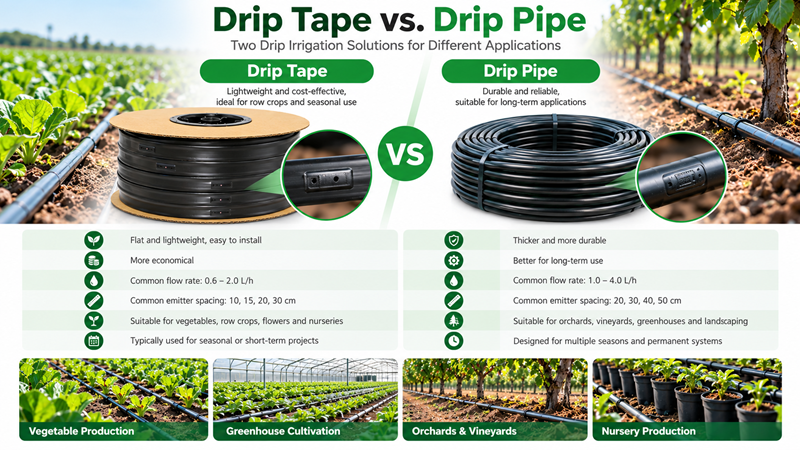
One of the most common decisions is whether to use drip tape or drip pipe. Both deliver water directly to the crop root zone, but they are suited to different applications.
Drip Tape
Drip tape is widely used for row crops, vegetables and seasonal agricultural production. It is lightweight, easy to install and available in different wall thicknesses, emitter spacings and flow rates.
Common drip tape options include:
- Flat emitter inline drip tape
- Labyrinth drip tape
- Pressure compensating drip tape
- Special color or multilayer drip tape for specific applications
Drip Pipe
Drip pipe generally has a thicker wall and is suitable for applications requiring greater durability and longer service life. It is commonly used in orchards, vineyards, greenhouses and other permanent or semi-permanent irrigation systems.
The right choice depends on the crop cycle, installation method, required service life and project budget.
Selecting only by unit price can lead to a product that does not match the actual application.
3. Choose the Right Emitter Spacing
Emitter spacing determines the distance between water outlets along the drip line. The suitable spacing depends mainly on plant spacing, crop type, soil conditions and the desired wetting pattern.
Closely planted vegetables often require shorter emitter spacing, while crops with wider plant spacing may use longer intervals. Soil characteristics also matter because water spreads differently in sandy, loamy and clay soils.
Instead of choosing emitter spacing independently, it is better to consider it together with crop spacing, emitter flow rate and irrigation duration.
4. Consider Emitter Flow Rate
Flow rate describes how much water each emitter delivers over a given period. The required flow rate can vary according to the crop, soil, climate, irrigation frequency and available water supply.
A higher flow rate is not automatically better. The objective is to deliver the appropriate amount of water while maintaining acceptable pressure and distribution throughout the irrigation line.
When comparing products, emitter spacing and flow rate should therefore be evaluated together rather than as separate specifications.
5. Match Wall Thickness to the Required Service Life
Wall thickness affects durability, handling and cost. Thinwall drip tape is commonly selected for seasonal applications, while thicker products are generally more suitable when greater mechanical strength or longer use is required.
Before selecting wall thickness, consider:
- Expected irrigation season or service period
- Installation above ground or under mulch
- Field conditions and handling
- Required resistance to mechanical damage
- Target product cost
For importers and distributors, local farming practices are also important. A specification that performs well in one market may not necessarily be the most suitable option in another.
6. Check Irrigation Line Length and Pressure
Irrigation line length has a direct relationship with pressure loss and water distribution. As water travels through the line, pressure changes can affect emitter discharge, particularly in long irrigation runs or uneven terrain.
Before confirming a drip irrigation product, consider the required lateral length, field elevation, operating pressure and desired irrigation uniformity.
For applications where pressure variation is a major concern, pressure-compensating products may be considered depending on the project requirements.
7. Water Quality and Filtration Matter
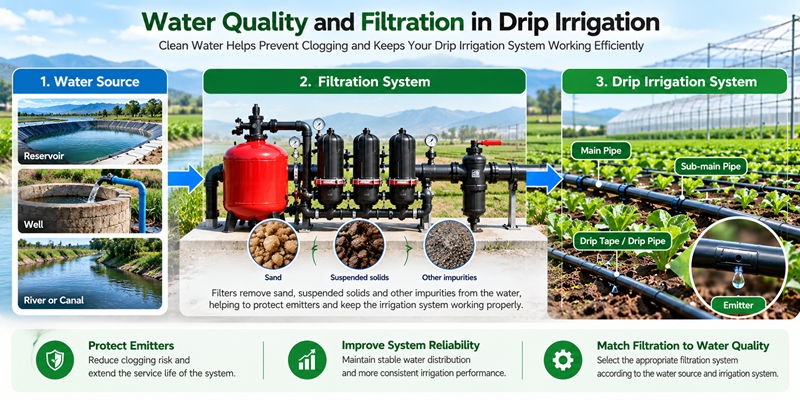
Emitter clogging is one of the most common problems in drip irrigation. Suspended particles and other contaminants in the water can enter small emitter passages and reduce irrigation performance.
The filtration system should therefore be selected according to the water source and the requirements of the irrigation equipment.
Common water sources include:
- Wells
- Reservoirs
- Rivers and canals
- Farm ponds
- Municipal or other supplied water
Water from different sources can contain different types and levels of contaminants. Appropriate filtration, system flushing and regular maintenance help reduce clogging risk and protect the irrigation system.
8. Do Not Overlook Fittings, Valves and Accessories
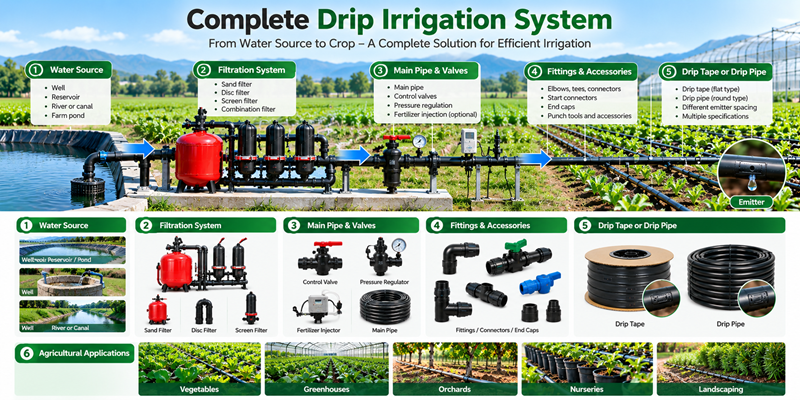
A drip irrigation system is more than the drip line itself. Fittings, valves, filters and accessories determine how water is connected, controlled, distributed and maintained throughout the system.
A complete system may include:
- Drip tape or drip pipe
- Main and sub-main pipes
- Connectors and fittings
- Control valves
- Filtration equipment
- End closures and flushing components
- Installation accessories
Compatibility between these components is important. Pipe diameter, connection type and operating pressure should be checked before the complete system is confirmed.
9. Evaluate the Complete System, Not Just the Product Price
Product price is important, especially for large agricultural projects and wholesale purchasing, but the lowest unit price does not always result in the lowest overall cost.
Product durability, installation efficiency, system compatibility, packaging, shipping efficiency and expected service life can all influence the real cost of an irrigation project.
Importers and distributors should also consider whether product specifications match the requirements of their local market and whether complementary components can be sourced together.
10. Information to Prepare Before Requesting a Quotation
Providing clear application and specification information makes it easier to identify suitable products and prepare an accurate quotation.
Useful information includes:
- Crop and application
- Required drip tape or pipe diameter
- Wall thickness
- Emitter spacing
- Emitter flow rate
- Roll length
- Required quantity
- Water source and operating conditions
- Required fittings, valves or filtration products
- Destination market or country
If the exact specification is not yet known, crop type, planting layout and application conditions can provide a useful starting point for product selection.
Choosing the Right Drip Irrigation Solution
There is no single drip irrigation specification that is suitable for every farm. The right solution depends on the crop, field conditions, water source, system layout, expected service life and budget.
BJLEON supplies a range of drip irrigation products and related components, including drip tapes, drip pipes, fittings, valves and filtration solutions. We also help importers, distributors and agricultural businesses compare product options and coordinate sourcing requirements from China.
Looking for a Drip Irrigation Solution?
Tell us your crop, required specifications, quantity and target market. BJLEON can help you explore suitable drip irrigation products and sourcing options from China.